

Artificial intelligence is transforming the way we work, no question about it. AI writes emails, generates images, sorts through mountains of data, and even chats with customers. Things that once needed a real person behind the scenes now, a machine can can now be handled by a machine
Maybe that’s the wrong way to frame it, though. Instead of asking what AI won’t touch, a more useful question is which jobs are actually difficult for it to fully take over and that naturally leads to wondering just how safe any job really is from AI.
The truth is, not many jobs are truly “AI-proof.” Technology isn’t slowing down, and roles that seem secure today might look very different in just a few years. Still, there are careers where people are hard to replace. Why? Because they lean on very human strengths: empathy, in-person presence, trust, creativity, leadership, and the ability to make sound judgments in complicated, messy situations.
A recent (2025) report from the International Lab our Organization found that about one in every four workers worldwide has some exposure to generative AI. report But here’s the twist: the report says jobs are more likely to transform than completely vanish, because most jobs need humans involved somewhere along the line.
That shifts the framing a bit — instead of asking which jobs AI will never touch, it’s worth asking which ones are simply hard for it to fully take over. It’s, “What jobs are tough for AI to take over entirely?”
9 Careers That Still Need Humans
1. Skilled Trades
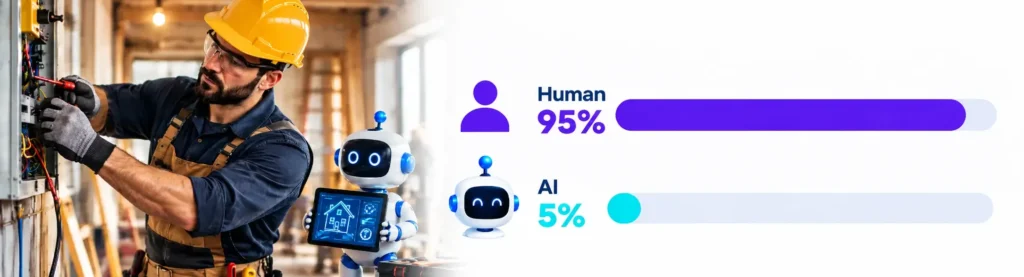
Electricians, plumbers, mechanics, carpenters, HVAC technicians, welders, and similar occupations are frequently overlooked when people begin discussing the future of jobs.
They can be challenging to automate due to the nature of the work environment.
A computerized machine can perform incredibly well in an isolated setting such as in an assembly plant, but in reality, a technician can meet all kinds of unique challenges on a job site.
He or she may arrive at the home or building where the task was supposed to take place and find that there are various complications beyond what was originally described.
The worker will need to examine the problem, possibly use a variety of tools, and get creative in order to solve it. This can require both manual dexterity and intellect.
An AI could potentially assist a tradesperson in identifying the issue, calculating expenses, and recognizing potential equipment, but someone still needs to go into the location and perform many repairs or adaptations to address what they find.
2. Construction and Field-Based Work
Construction workers, site supervisors, inspectors, and project managers operate in environments that constantly change.
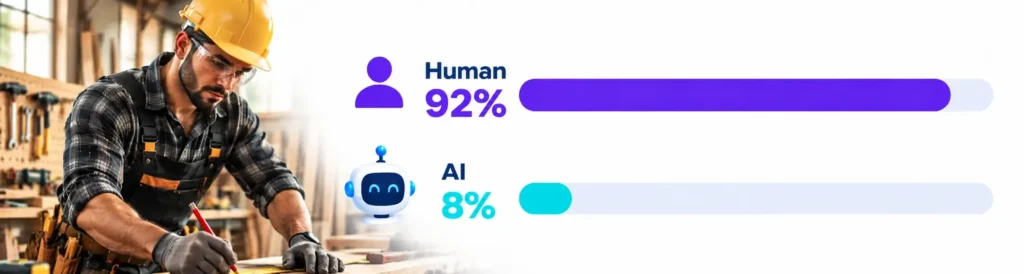
Unlike a digital workspace, a construction site can’t be fully controlled or predicted. The weather can change. Materials can arrive late. Equipment can fail. Measurements may need to be adjusted. Workers have to coordinate with each other while following safety requirements. Automation will certainly enter construction. Robots may handle specific repetitive or dangerous tasks, while AI can help with planning and project management.
However, large parts of construction still require humans who can physically interact with the environment and solve unexpected problems .The more varied the physical environment, the harder complete automation becomes.
3. Leadership and Management Roles
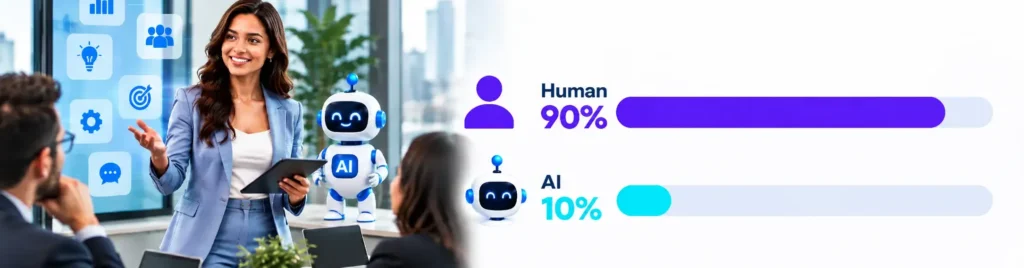
Leadership mostly comes down to making calls when you don’t have all the information you’d like. Managers are constantly juggling personalities, conflicts, motivation, deadlines, office politics, priorities that shift overnight and none of that stuff comes with a clean answer sitting in some historical dataset.
Consider a manager whose team is struggling. The problem might not be productivity. Perhaps two employees are in conflict. Maybe someone is burned out but afraid to say it. Perhaps the team has lost confidence after a failed project. A spreadsheet may show the symptoms, but a human leader has to understand the underlying situation.
And a lot of leadership really just comes down to trust. People need to actually believe that whoever’s making the call understands what they’re dealing with, and will own the outcome either way. AI can crunch the numbers and help a manager think things through, sure but leadership itself is still, at its core, about the relationships between people.
4. Creative Professionals
Creativity might be the messiest part of this whole AI debate. Sure, AI can spit out artwork, music, copy, video ideas, even full ad concepts in a matter of seconds so yeah, a lot of creative grunt work is getting easier to hand off. But creativity was never just about producing a picture or stringing together a paragraph. The professionals who actually succeed at it get people’s culture, emotion, context, why an idea matters in the first place.
Take a brand strategist: their real job is figuring out why a certain message clicks with customers. A filmmaker is deciding, scene by scene, what feeling they want the audience to walk away with. An art director is shaping a whole visual identity that actually fits who the brand is. AI can throw a bunch of options on the table, sure but humans are still the ones deciding what any of it actually means. So creative professionals who figure out how to use AI as just another tool in the kit will probably find their work shifting shape, not vanishing.

5. Mental Health and Counseling Professionals
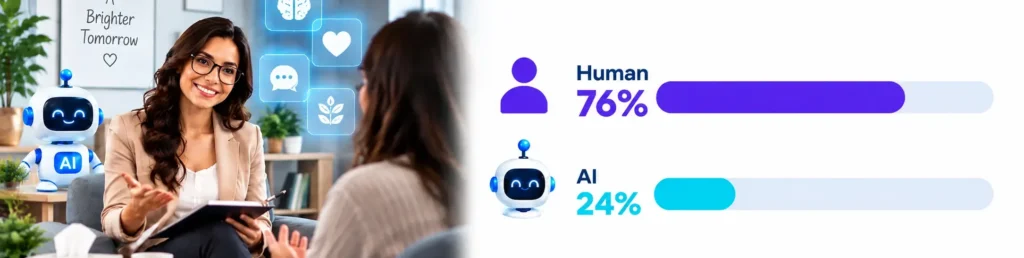
Counselors, therapists, social workers, and other professions that deal with people’s emotional problems are concerned with matters of trust and understanding. While a computer program can offer listening ears and some general advice, professionals in the field are concerned with the history, relationships, environment, conduct, and body language of the client.
Moreover, many people seek human interaction and genuine understanding.
A conversation with a machine, no matter how well-intentioned, cannot replace a genuine human connection for many people. People seeking help may want to have a conversation with another person and not rely on somebody’s pre-set algorithms.The profession has a responsibility and high ethical standards to guide their conduct.
6. Sales and Relationship-Based Business Roles
Sales jobs built around repetitive outreach are probably the first to get automated. AI can already draft sales emails, spot potential customers, sort leads, and handle the basic back-and-forth questions on its own. But once you get into high-value sales, it’s really a relationship game.
Say a company’s weighing a big purchase, that decision usually drags in multiple people, competing priorities, some nervousness about risk, and a whole lot of “can we actually trust this person.” Figuring out what the customer’s really after and pitching it in a way that sticks comes down to the salesperson’s judgment.
Negotiation is even trickier, honestly, because it’s so situational. People rarely just say what they mean outright half the time, the real message is in what they’re not saying. So the salespeople who stay sharp at communication, negotiation, and just building real relationships? They’re going to keep their edge, even with AI picking up more of the admin-heavy stuff.

7. Teachers and Educators
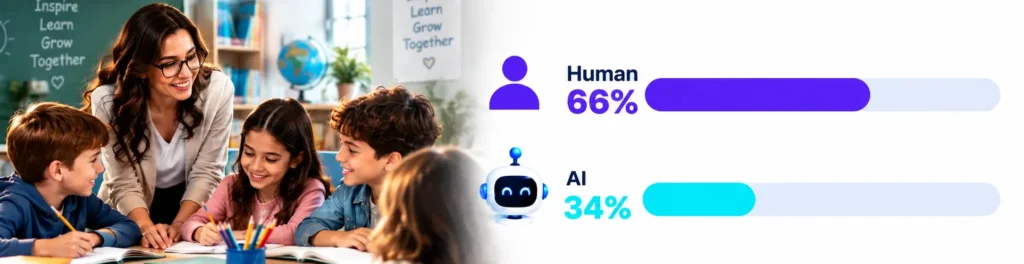
Education is another area in which human interaction is of utmost importance.
While an AI may be able to teach a student math, produce quizzes, summarize textbooks, and offer practice problems, that does not mean that the teacher’s job is done.
A teacher teaches far more than just the subject at hand.
A teacher can recognize when a student is confused on a certain topic, even if they do not ask questions. They can know when a student needs encouragement rather than an explanation. Teachers can control the classroom, settle disputes, inspire, and empower their students to be better people.
Finally, teachers serve as a model for their students. The students will likely forget the exact lessons that were taught in school, but they will always remember the good times experienced with the teacher. An AI may be able to help with education, but the teacher’s role in the learning process is far too personal to be replaced.
8. Emergency and First-Response Jobs
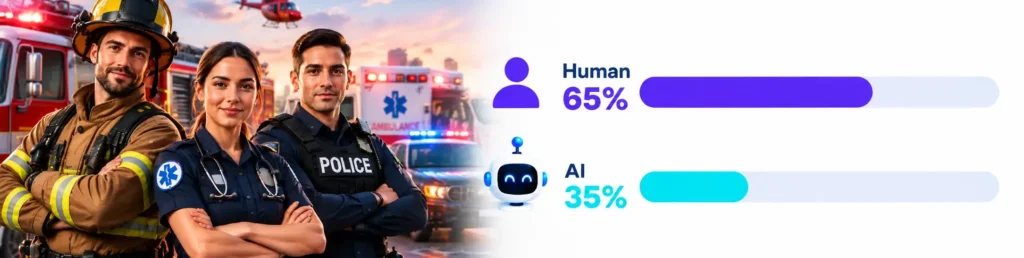
Firefighters, paramedics, and other emergency responders rarely get to work from a script. Things hardly ever go the way they were planned, and emergencies are no exception.
A firefighter has to size up a burning building and make calls before the fire’s even under control. A paramedic might be treating someone on the shoulder of a highway with traffic still moving past, no time to think it through carefully. Someone leading a response team has to make snap decisions on the spot while a whole group of people is looking to them for direction.
Robots and AI could undoubtedly assist in the areas of dangerous work, surveillance, and reconnaissance.
Still, this kind of work usually comes down to physical effort, reading the environment as it changes, dealing with people face to face, and deciding things fast. When the situation shifts, responders don’t get a moment to pause — they have to read what’s happening right then and act on it.
9. Healthcare Professionals
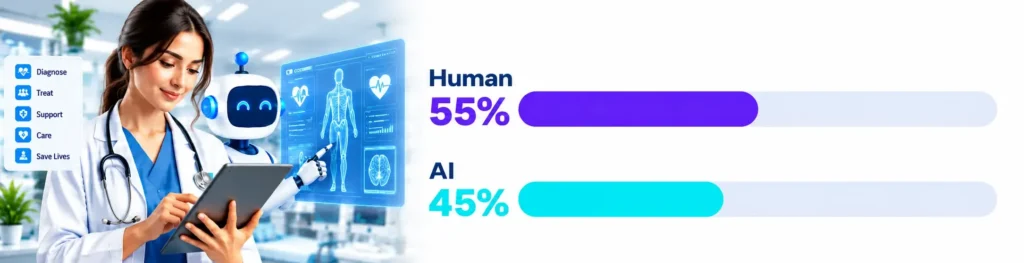
Healthcare is one of the obvious areas where AI can be integrated into the process to help humans rather than replace them. Doctors, nurses, physiotherapists, paramedics, occupational therapists, and a variety of other professions directly interact with patients in ways that go beyond simply identifying and addressing symptoms.
A doctor reviewing scans and test results using an AI system still has to explain the diagnosis to the patient and consider their individual case in context with the symptoms.
A nurse’s job requires them to offer physical care, reassurance, observation, and assistance beyond what an algorithm can handle at this point in time.
And a paramedic tasked with getting a patient to the hospital has to think through what has happened to them and how to safely move them, beyond simply reading the emergency alert when they arrive on the scene.AI can be integrated into healthcare to help professionals do their jobs better, but a person remains essential to the process.
Does This Mean AI-Proof Jobs Exist?
No job is 100% safe: even if a job seems “boring” or simple, there is always some risk of automation.
The question is being asked the wrong way: instead of asking, “Will AI take my job?” we should ask, “Which parts of my job can AI do, and what skills should I develop to stay valuable?”
Graphic design are a good example: Those who do not learn to use AI may fall behind people who integrate AI into their work. Let AI handle boring or repetitive tasks, while you focus on strategic and higher-level work.
The same idea applies to every profession: programmers, marketers, teachers, accountants, and many others.
Main point/conclusion: AI should not be treated as an enemy. Instead, it can be used as an ally, a tool that helps improve the quality of your work and makes you more productive.
Conclusion
This whole “what jobs are safe from AI?” Framing it as “which jobs are safe from AI” makes it sound like every worker will end up sorted into two piles — spared or replaced. That’s not really how it plays out. But reality is much more nuanced, as we shall see.
AI will probably automate certain aspects of many jobs, but there are likely to be enough elements of most professions that involve people, animals, environments or require a high degree of human judgement that they will resist complete automation.
That is not to say that those in these professions should ignore new developments, it is more likely that the best move for most people will be to identify how their human skills can be applied in concert with computers.
After all, computers are good at some things (analysis, projections, crunching large sets of numbers) and humans are generally better at others (relationships, synthesis, nuance, analysis of nuance, people management, leadership and creativity).
And remember, the best advantage is being the person who knows how to work with AI, not against it.In the future doctors will use AI to diagnose problems, designers will use it for a million drafts, coders will code with machine help, and teachers will use it to teach students individually. But it is still up to the people to decide what is important and what to do.