
Spend any time reading about SEO and sooner or later you’ll bump into the word “backlinks.” Everyone seems to have an opinion on them. People brag about earning one from a big site, panic when they lose one, obsess over their “link profile” like it’s a credit score. Fair question though what is a backlink, really, and why does it get so much attention? Does having a bunch of them actually push you up on Google?
Not exactly. Backlinks can help, sometimes a lot, but it depends. Who’s linking to you, why they bothered, and whether the link actually sends someone somewhere useful that stuff matters way more than just how many links you’ve racked up.
I want to walk through what a backlink even is, how it works, why SEO people can’t stop talking about them, the different kinds you’ll run into, and a few realistic ways to get them without doing anything spam.
What Is a Backlink in SEO?
Strip away the jargon and a backlink is just one website linking to another. That’s it.
Say a tech publication is writing about online security, and somewhere in the piece they drop a link to a genuinely useful resource on your site. That’s a backlink a link pointing from their domain into yours.
You could think of it as a nod of approval. When a site links to your page, it’s basically telling its own audience, “go check this out too.”
Some people call these inbound links, or incoming links same idea, just different phrasing. They carry visitors from someone else’s corner of the internet over to yours.
Website A → links to → Website B
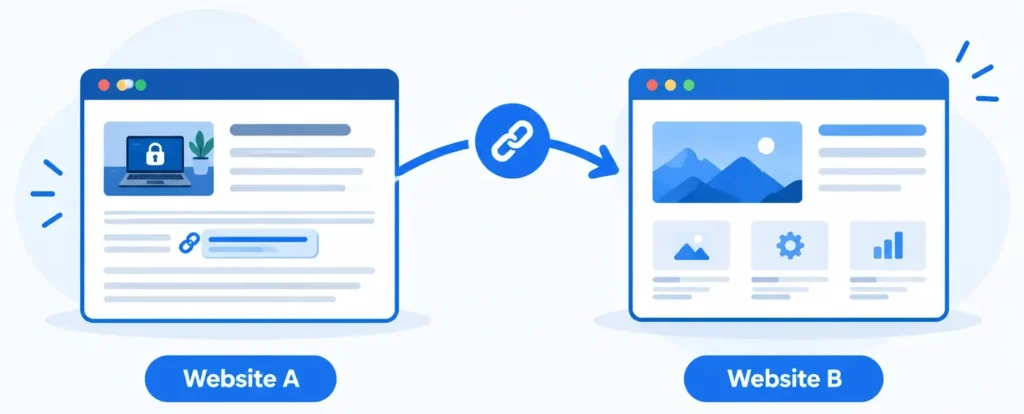
From Website B’s side, that’s a backlink.
Worth pointing out the difference between this and internal linking, which just connects pages within the same website. A backlink, by definition, has to cross from one domain to a completely different one.
Why This Actually Matters for SEO?
Search engines juggle a huge number of signals when deciding what a page is about and whether it deserves to rank. Backlinks are one signal among many, not the whole story, just a piece of it.
When several relevant, credible sites link to the same page, it can hint to search engines that the page might actually be worth showing people. Here’s what a lot of newcomers overlook, though all backlinks are not equal in value.
One link from a genuinely respected, topic-relevant site can outweigh a hundred links scraped together from random low quality domains. Say you wrote a solid, detailed piece on graphic design. A mention from an established design or business publication that actually references your work does more for you than a mass of unrelated links ever could.
That’s basically why link building has changed. It used to be about volume. Now it’s about earning attention from the right places, quality over quantity, as the cliché goes, except here it’s actually true.
How Backlinks Actually Affect Rankings
There are a few concrete ways backlinks contribute to SEO. None of them are a guarantee on their own, though.
They Can Build Authority
When trustworthy sites link back to you, it shapes how search engines read your site’s overall credibility. It functions somewhat similarly to a personal recommendation. One friend recommending a restaurant might catch your attention, but if three or four people you actually trust say the same thing, you’re probably going.
The comparison isn’t exact, obviously. Search engines run far more complicated calculations under the hood. But the basic logic recognition passed between sources still applies.
They Help Search Engines Find Pages
Links double as pathways for crawlers. When a crawler follows a link from one page to another, it can discover URLs it hadn’t indexed yet.
This matters especially for newer sites, or for pages that are buried a few clicks deep and hard to reach through normal navigation. Sitemaps and internal links help too, sure but external links open up another route in.
They Bring Referral Traffic
Here’s something that gets overlooked a lot: a backlink can send real people to your site, not just search engine crawlers.
If a well-read blog mentions your article and links it, some of their readers will actually click through. That’s referral traffic, and it’s proof that a good backlink has value even outside of SEO. It introduces your work to an audience you might never have reached otherwise.
They Build Visibility Over Time
The more your site gets mentioned across your industry, the more familiar your name becomes to people in that space. Over months, your brand starts showing up in different articles, resource lists, forum threads.
That repetition builds recognition but again, only when the mentions are genuine and relevant. Getting your link stuffed into fifty unrelated pages doesn’t build the same kind of trust.
A Quick Look at Everyday Backlink Scenarios
Here’s a simple breakdown of how backlinks show up in real situations and what they actually do:
| Everyday Example | How the Backlink Helps |
| A blogger links your guide in a “further reading” section | Sends genuinely interested readers your way |
| A journalist cites your research in a news piece | Adds credibility, sometimes triggers more coverage |
| A business links your tool in a resource roundup | Puts your product in front of a relevant new audience |
| Someone shares your article in a forum thread | Brings direct, topic-matched traffic |
| An industry directory lists your site | Helps people discover you within your niche |
| A partner mentions you in a case study | Borrows credibility from an established name |
Types of Backlinks Worth Knowing
Not all links function the same way. Knowing the categories makes the whole topic less confusing.
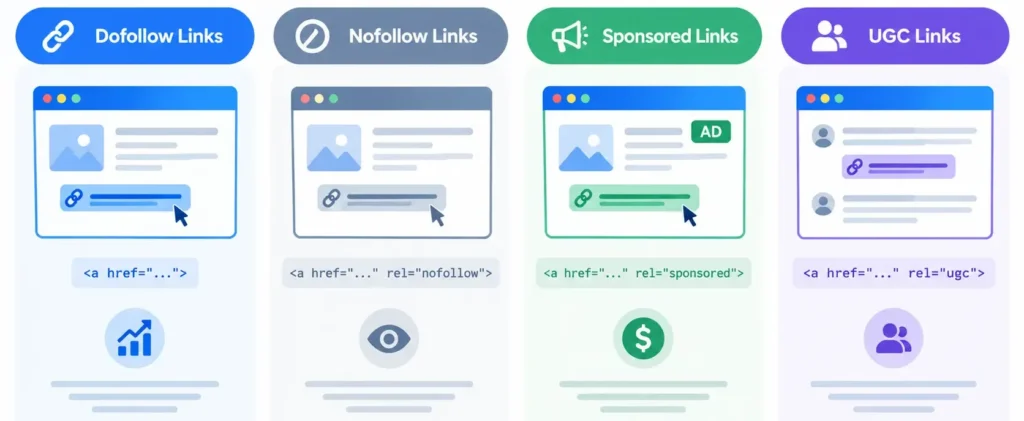
Do follow Links
A normal link that passes on the usual link signals gets casually called “do follow” in SEO circles. Worth knowing it’s not something you typically add manually. It’s just terminology used to separate ordinary links from ones carrying special attributes, like no follow.
No follow Links
A no follow link carries the rel=”no follow” attribute, basically telling search engines the site isn’t vouching for the destination in the usual sense.
That doesn’t make it useless, though. It can still send traffic your way, build visibility, and sometimes leads to other people noticing and linking to you organically later.
Sponsored Links
Used for anything tied to advertising or a paid arrangement. Google made the rel=”sponsored” attribute specifically for this.
Being upfront about paid placements matters, buying links purely to manipulate rankings breaks search engine guidelines. If it’s an ad, it should be labeled and treated as one.
UGC Links
UGC User Generated Content. The rel=”ugc” attribute applies to links that show up in comments, forum replies, or anything submitted by users rather than posted by the site owner directly.
So What Actually Makes a Backlink “Good”?

New SEO folks often assume the best backlink is simply whichever comes from the site with the biggest authority score. That’s only half the picture, honestly.
Relevance counts for a lot. If you run a web development blog and a tech outlet links your guide naturally, that makes sense contextually. A completely unrelated site linking the same page doesn’t carry that weight.
The source matters too; it should be legitimate, not some sketchy domain nobody trusts. It doesn’t need to be huge, either. A smaller, respected site in your specific niche can still be worth plenty.
Context matters. A link that fits naturally into a paragraph, placed because it genuinely helps the reader, is a completely different thing from a link stuffed in awkwardly just to tick a box.
And honestly, what’s on the other end of that link might matter most of all. If someone clicks through and lands on something genuinely useful, they stick around. That’s the whole point.
Realistic Ways to Earn Backlinks

You don’t need to blast out five hundred cold emails to get links. There are better ways.
Make something worth citing. Detailed guides, original data, free tools, real case studies content people actually want to reference when they’re writing about the same topic. Ask yourself honestly: if another writer stumbled on this page, would they bother linking it?
Guest writing, done properly contributing real value to another relevant site rather than churning out filler just to squeeze in a link back.
Digital PR, when you actually have something worth covering. Reach out to journalists or industry writers, but lead with what their audience would care about, not a request for a favor.
Build resources people naturally want to link to original research, free calculators, detailed tutorials, industry stats, templates. These give other writers something concrete to point at.
Should You Just Buy Backlinks?
Careful here. Buying links specifically to game your rankings goes against Google’s policies, plain and simple.
That said, not every paid placement online is shady, sponsorships and ads exist everywhere, and that’s fine as long as it’s transparent. The line is between advertising (labeled honestly) and paying purely to manipulate search results.
Is More Always Better?
Not really. Picture two sites: one has 500 backlinks from random, unrelated domains. The other has 30 links, all from genuinely relevant sources that actually reference useful content.
On paper, the first one looks stronger just by the numbers. In practice, search engines weigh a lot more than raw count which is exactly why obsessing over the number distracts from what actually matters: earning the right mentions from the right places.
Mistakes People Keep Making
A handful worth avoiding: chasing links from completely unrelated sites just because they’re easy to grab. Reusing the exact same keyword-stuffed anchor text over and over natural links varies in wording, always. Trusting anyone selling “1000 backlinks” for a few dollars. And forgetting that the page receiving all these links still needs to actually be good no backlink fixes weak content or a confusing site.
What to Remember
Backlinks are a real part of what makes SEO work, but they were never supposed to be some kind of shortcut.
Strip it down and a backlink is just one site pointing at yours. If it’s coming from somewhere relevant, somewhere people actually trust, and it genuinely helps whoever clicks it that single link can do a lot at once. It boosts how findable you are, builds your authority, sends you traffic, and adds to your reputation.
So rather than chasing a bigger number, put the energy into building stuff that’s actually worth linking to. Build real relationships with other sites in your niche. Offer something of genuine value. Once people have a real reason to point to your work, backlinks stop feeling like some tactic you’re running they just happen naturally, because you’ve built a site people actually trust.