
Last time you needed a dentist, or a cheap flight, or a fix for some weird laptop error, what did you do? You Googled it. Then you probably clicked something on the first page and never looked at page two.
Every business owner should think about that habit for a minute. If you’re not on that first page, a huge number of people simply never meet you.
SEO is the thing that changes that. The letters stand for Search Engine Optimization, and the idea is straightforward: you shape your website so Google and other search engines understand what you offer, and so people who are searching for it can land on you.
A lot of beginners think SEO means repeating a keyword fifty times. It doesn’t, and that trick stopped working years ago. Real SEO is a mix of good content, a clean site, decent speed, links from other websites, and a pleasant experience for whoever shows up. Let’s go through it piece by piece.
What Is SEO in Digital Marketing?
Inside digital marketing, SEO is the channel that earns you free (organic) visibility in search results. Nobody bills you per click.
Take “web development services for small businesses.” Search that and you’ll get a bunch of agencies. The ones near the top usually didn’t get there by luck. They wrote helpful pages about the topic, kept their sites tidy, and made it obvious what they do.
Here’s what matters most: SEO isn’t really about traffic numbers. A thousand random visitors who leave in five seconds are worth less than twenty people who were actually looking for your service. SEO is good at finding those twenty, because they came to you after searching for it themselves.
One warning, though. “No cost per click” doesn’t mean “no cost.” You’ll spend time, or money, on writing, research, fixing technical problems and checking your stats. It’s a slow-burn investment.
How Does SEO Work?
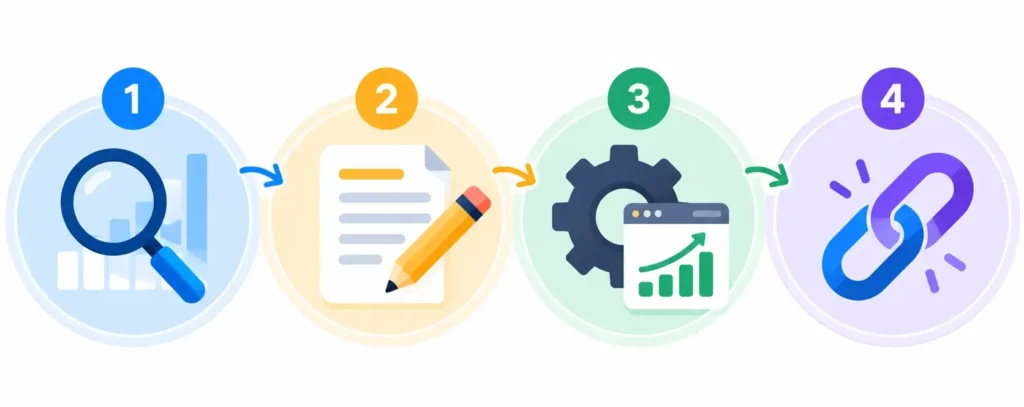
Search engines send out automated bots that crawl the web, read pages, and file them away in a giant index. When you type a query, the engine digs through that index and ranks the pages it thinks fit best.
Your job is to make your pages easy for those bots to read, and good for the humans who follow. Roughly, it goes like this.
1. Keyword Research
First, you find out what words and phrases people actually type. A person trying to learn SEO from scratch could type queries like:
- What is SEO?
- SEO in digital marketing
- How does SEO work?
- SEO benefits
- Types of SEO
Searches like these tell you what people are curious about, and that gives you ideas for content that answers them
2. Creating Useful Content
Now you write the answers. Not fluff, the actual answers. If the article is “SEO for small businesses,” it should tell a shop owner what to do first, what to ignore, and where people usually waste money. Examples, screenshots, steps and numbers all help, depending on the topic.
3. Optimizing the Website
This is the tidy-up phase: page titles, headings, URLs, internal links, image sizes, loading speed, and how the site looks on a phone. None of it is glamorous. All of it adds up.
4. Earning Authority
When other trustworthy sites link to yours, search engines take that as a sign your page is worth paying attention to. That’s why many businesses put effort into content marketing, digital PR and guest posting alongside the rest of their SEO.
Types of SEO in Digital Marketing
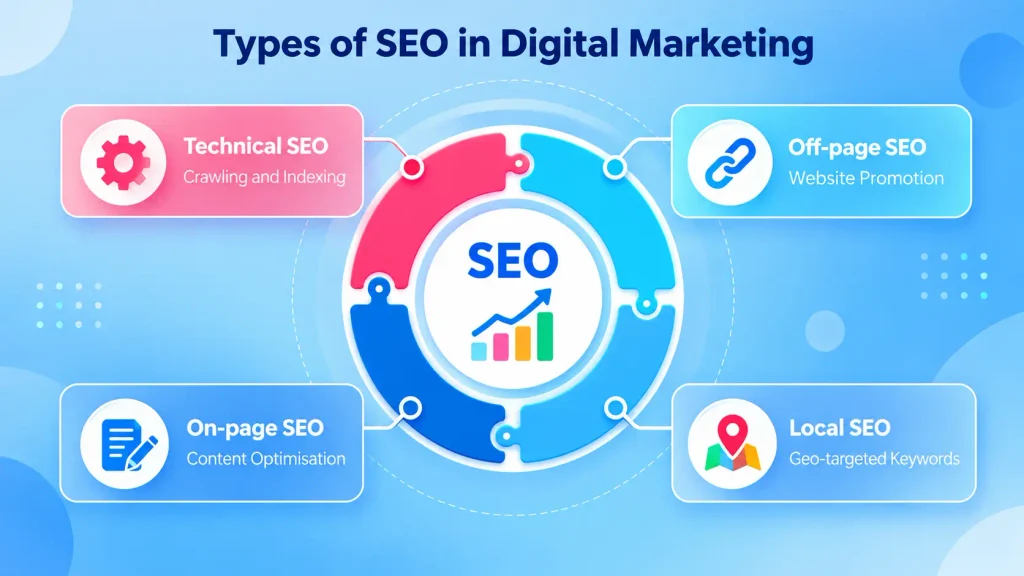
People talk about SEO like it’s one skill. It’s really a handful of different jobs.
On-Page SEO
On-page SEO deals with the actual content and elements sitting on your page, such as:
- Page titles
- Headings
- Keywords
- Content
- Meta descriptions
- Internal links
- Image optimization
- URLs
If you publish an article about SEO benefits, for example, the page should explain those benefits clearly and use headings that help people skim and follow along. The goal is a page that’s useful, easy to understand and relevant to the search.
Off-Page SEO
This happens away from your site. Link building is the famous one. If an industry blog calls your guide useful and links to it, that counts for a lot. Digital PR, guest posting, brand mentions and promoting your content live here too.
that adds to your site’s authority.
Other off-page activities include:
- Link building
- Digital PR
- Guest posting
- Brand mentions
- Content promotion
Quality matters far more than quantity here. A few relevant, trustworthy links beat a pile of random ones.
Technical SEO
Technical SEO is the foundation under everything else. It includes:
- Website speed
- Mobile usability
- Crawlability
- Indexing
- Site architecture
- XML sitemaps
- HTTPS
- Structured data
- Broken links
You can have brilliant content, but if search engines struggle to crawl your pages, or the site loads painfully slowly, that content may never get its chance. That’s why technical SEO belongs in any complete strategy.
Local SEO
Some searches have a place baked in: “SEO agency near me,” “web development company in London.” Local SEO is how you show up for those. It’s a big deal for restaurants, clinics, shops, contractors, and any business whose customers live nearby.
Content SEO
Content SEO starts with a simple question: what are people actually typing into Google? Once you know that, you figure out what they really want from the search (that’s search intent), dig into the topic, lay the page out so it’s easy to follow, and give an answer that’s worth reading.
Say a company sells web development. It might write pages like these:
- What Is Web Development?
- How Much Does a Website Cost?
- What Is Responsive Web Design?
- How to Choose a Web Development Company
Every one of those is a question a customer has probably asked already. Answer them well and the traffic can come in on its own.
Benefits of SEO in Digital Marketing
1. More organic traffic
Once you rank for the right queries, visitors arrive without you spending money on every single click. One good informational page can keep bringing in visitors for months, sometimes years.
2. Better visibility
If people can’t find you, they can’t hire you. Each relevant query where your page shows up becomes another opportunity to be found.
3. A more targeted audience
A person typing “what is SEO” is simply at the learning stage. Someone who searches “SEO services for small business” is much closer to making a purchase. Once you see that gap, you can write for each stage and stop sending one message to everybody.
4. Staying power
The moment ad spending stops, paid traffic disappears almost immediately. A solid page doesn’t behave like that. It can keep working long after you hit publish, although rankings do move around, so plan to refresh old content now and then.
5. Brand recognition
If someone sees your company in three helpful articles while researching, your name starts to feel familiar. They may not buy that day. They’ll remember you, though.
6. Business growth
Getting more of the right visitors onto your important pages makes a real difference. For a service company that’s service pages, for a store it’s product pages, for a blog it’s readers. How much you gain depends on your industry, your competitors, your site and the demand out there, so be skeptical of anyone who promises specific results.
Simple Examples of SEO
A handful of simple examples can help make this idea clearer.
Example 1: Web Development Company
A web development company wants to win over small businesses. Rather than relying on one service page, it publishes articles like “How Much Does a Business Website Cost?” and “What Makes a Website Mobile-Friendly?” These target the questions people tend to ask before they contact a developer.
Example 2: Local Business
Picture a digital marketing agency in Manchester. It could build a page dedicated to its Manchester services and publish useful local marketing content, helping it show up for searches linked to that location.
Example 3: SEO blog
A site publishes a deep article about backlinks: what they are, what kinds exist, and the link-building mistakes that get people in trouble. If readers find it genuinely helpful, it can keep bringing in people interested in SEO.
SEO vs Paid Advertising

With paid ads, you pay a platform to show your message to a chosen audience. As soon as the budget disappears, the traffic disappears with it. SEO works differently, since it’s about earning your place in organic results rather than renting it.
It isn’t free, to be clear. Writers, developers, tools and outreach all cost something. Unlike search ads, this approach doesn’t charge you for every individual click. Plenty of companies run both, since ads give quick results while SEO builds up slowly.
Common SEO Mistakes
Most SEO trouble comes from taking shortcuts. The usual suspects:
- Stuffing keywords into every sentence
- Publishing thin articles that say nothing new
- Copying content from other sites
- Ignoring technical problems
- Buying cheap backlinks
- Writing misleading page titles
- Forgetting that most people browse on phones
- Creating content without checking search intent
- Leaving old information to go stale

Fix those and you’re already ahead of a surprising number of websites. Write for people first, and keep the technical side in good shape.
How to Get Started With SEO
If you’re new, don’t try to fix everything this week. Pick one small thing and finish it.
Begin by identifying the audience you actually want to target. What would they type into Google if they needed you? Write down ten or fifteen of those searches, then keep the ones that match something you really sell or do. That’s your keyword research. For a beginner, it doesn’t need to be fancier.
Next, open your own site on your phone and poke around. Are your key pages reachable within just two or three taps? Does each page title say what’s on it? If you get lost, visitors will too, and so will Google.
Technical stuff comes after that: slow loading, broken mobile layouts, pages Google can’t crawl or index. Most such issues get picked up by free tools such as Search Console and Page Speed Insights.
Then publish. One useful article a week beats ten rushed ones in a single month. Share each piece wherever your audience already hangs out.
Check your numbers once a month or so: rankings, organic traffic, clicks, impressions, conversions. Some pages will surprise you. Improve the ones that are close, and stop wasting time on the ones that flop.
Frequently Asked Questions
Is SEO part of digital marketing?
Yes. Honestly, it’s the part many marketers start with, because search traffic tends to be ready to act. If someone is typing a question into Google, they’re already looking for a direct answer.
Is SEO free?
Sort of. Google won’t bill you for a click, but almost everything else can cost something: a writer, a tool subscription, a developer to fix a slow site. If you do it all yourself, the bill is your evenings.
How long does SEO take to work?
Longer than you’d like. For a brand-new site, I’d expect three to six months before you see real movement, and more if the competition is strong. A small local business may see something sooner. If an agency promises an exact date, be a little suspicious.
What are the main types of SEO?
You’ll hear about five. On-page covers what’s on your pages, like titles and copy. Off-page is mostly backlinks. Technical is speed, crawling, and mobile. Local helps you show up for “near me” searches, and content is the articles and guides themselves. They overlap quite a bit, so don’t worry about where one ends and the next begins.
Why is SEO important for a business?
Because people search right when they need something. Show up at the right moment, and the visit follows naturally. Ads stop the moment your budget does, but a page that ranks keeps working while you sleep.
Conclusion
The importance of SEO in digital marketing should not be underrated. SEO isn’t magic, and it isn’t a one-month fix. At its core, it’s about being found by the right people: understanding what they search for, building pages that answer it, keeping your site fast, and earning trustworthy links over time. Each part of SEO is just a different job working toward the same goal, helping search engines understand your site and helping real visitors find something useful.
The results won’t show up overnight, and some months will feel quiet. But for most small businesses, a solid foundation keeps bringing in traffic long after the work is done.